Measure 15-240: Renewal of Five-Year Local Option Tax for General Operations. This measure renews current local option taxes.
QUESTION: Shall District continue imposing $0.13 per $1,000 assessed value for five years beginning July 1, 2026 to fund general operations?
SUMMARY: This is not the State transportation bill, this is a local tax renewal. The Rogue Valley Transportation District (RVTD) currently operates six routes serving Medford, Ashland, Phoenix, Talent, Central Point, and White City. RVTD provides public transportation services, including ADA paratransit, within the territory of the District, Monday through Friday between 6:00AM and 6:30PM. If adopted, this measure would continue a 5-year local option levy at the same rate of $0.13 per $1,000 assessed value that was ap-proved in 2016 and 2021. Without renewal, the current tax levy will expire June 30, 2026.
Renewing the local tax levy allows RVTD to maintain bus service District-wide providing access to education, healthcare, jobs, affordable housing and goods and services that meet basic needs. Without the levy funding renewal, RVTD cannot maintain current bus service to our community. RVTD provided over 1 Million rides in the previous year, primarily serving older adults, low-income individuals, families and persons with disabilities. Levy funds will be used to maintain and enhance bus service based on community feedback and available funding.
The proposed tax rate will raise approximately $2,846,254 in 2026-2027, $2,960,204 in 2027-2028, $3,078,508 in 2028-2029, $3,201,649 in 2029-2030 and $3,329,715 in 2030 -2031. The estimated tax cost for this measure is an ESTI-MATE ONLY based on the best information available from the county assessor at the time of the estimate and may reflect the impact of early payment discounts, compression and the collection rate.
Explanatory Statement
The Rogue Valley Transportation District (RVTD) provides public transit and paratransit service to Medford, Central Point, Ashland, Phoenix, Talent, White City, and Jacksonville. RVTD is more than just a bus service. RVTD provides Valley Lift ADA service to older adults and disabled individuals who are unable to use the bus. RVTD also provides programs to improve bicycle and pedestrian safety, to enhance employee commute options and to offer an affordable transportation option for youth, seniors, low-income and vulnerable populations that cannot drive.
A ‘Yes’ vote allows RVTD to maintain bus routes ensuring access to education, healthcare, employment, affordable housing and the goods and services that support everyday needs. Service will also be expanded based on community feedback. This measure does not raise the current tax rate, it continues funding transit at 13 cents per $1,000 of assessed value for five years.
A ‘No’ vote will result in additional service cuts to what was already eliminated in 2025 due to funding uncertainty and the escalating costs to provide transportation. Last year’s reductions eliminated several routes, scaled back daily schedules, and eliminated Saturday service.
Public transit is a critical service for your community. RVTD conducted a passenger survey in 2025 to find:
- 65% of riders rely on and use transit every day
- 70% of passengers do not have a car to use
- 54% of passengers are employed yet 68% of riders make less than $25,000 per year
- 25% of riders are disabled or retired and 10% are students
- 7% of trips are to medical appointments, 8% to commerce/shopping and 6% to essential services
- 24% of riders would not have made the trip at all if bus service were not available
The same passenger survey found that passengers and regional employers want weekday evening hours and Saturday service to be restored. With the passage of the levy, RVTD will continue to seek community and rider feedback on service additions the renewal levy could fund.
Transit service and routes have fluctuated over RVTD’s 50-year history due to available local, state and federal funding. Due to federal and state funding issues, RVTD recently cut service by 40% resulting in the suspension of 10 bus routes, weekday evenings, and Saturday service. RVTD reduced staff by 66 employees, which was nearly half of RVTD’s workforce. Due to the continuing Federal Transit Administration funding delays and ODOT’s own funding challenges, RVTD cannot rely on these funds to provide all of our community’s transit needs. This levy is our community’s local contribution and will provide a reliable source of revenue to fund bus routes and ADA services to our most vulnerable community
members.
Passenger fares, bus advertising, clean fuel tax credits and more contribute to RVTD’s revenues by 16% helping to offset overall expenses. Local voters supported RVTD in 2016 and 2021 for the first time in over thirty years. This tax measure will continue the current tax rate of 13 cents that was approved before. Homeowners with a taxable home value of $300,000 would pay $39.00 per year.
Click here to see the RVTD District Map
Frequently Asked Questions
Is this a new tax or renewal?
What will RVTD use the funds for?
What happens if the levy does not pass?
Why is transit service important?
The benefits of transit service include access to jobs and higher education. Transit improves local commerce through access to shopping. Transit increases mobility and improves livability for our community. Transit is reliable and safe transportation. Transit helps reduce congestion and improves air quality.
RVTD’S 2025 passenger survey shows that:
70% of passengers have zero working cars available to their household and rely on the bus for their means of transportation
65% of riders use transit every day of the week it is available
68% of riders make less than $25,000 per year and are living in poverty
54% of passengers work either full or part-time and rely on the bus to get to work
25% of riders are disabled or retired and rely on RVTD for their transportation
10% are students who travel long distances to reach RCC and SOU
18% of trips were to reach goods and services that meet basic needs
What happened in 2025 that caused services to be cut?
RVTD is a public agency and receives funding from local, state and federal sources to operate transit. These funds have remained flat, or even decreased, over the past five years as costs have increased. RVTD’s primary costs are the operation of buses which include ongoing maintenance of buses, fuel and trained professional drivers.
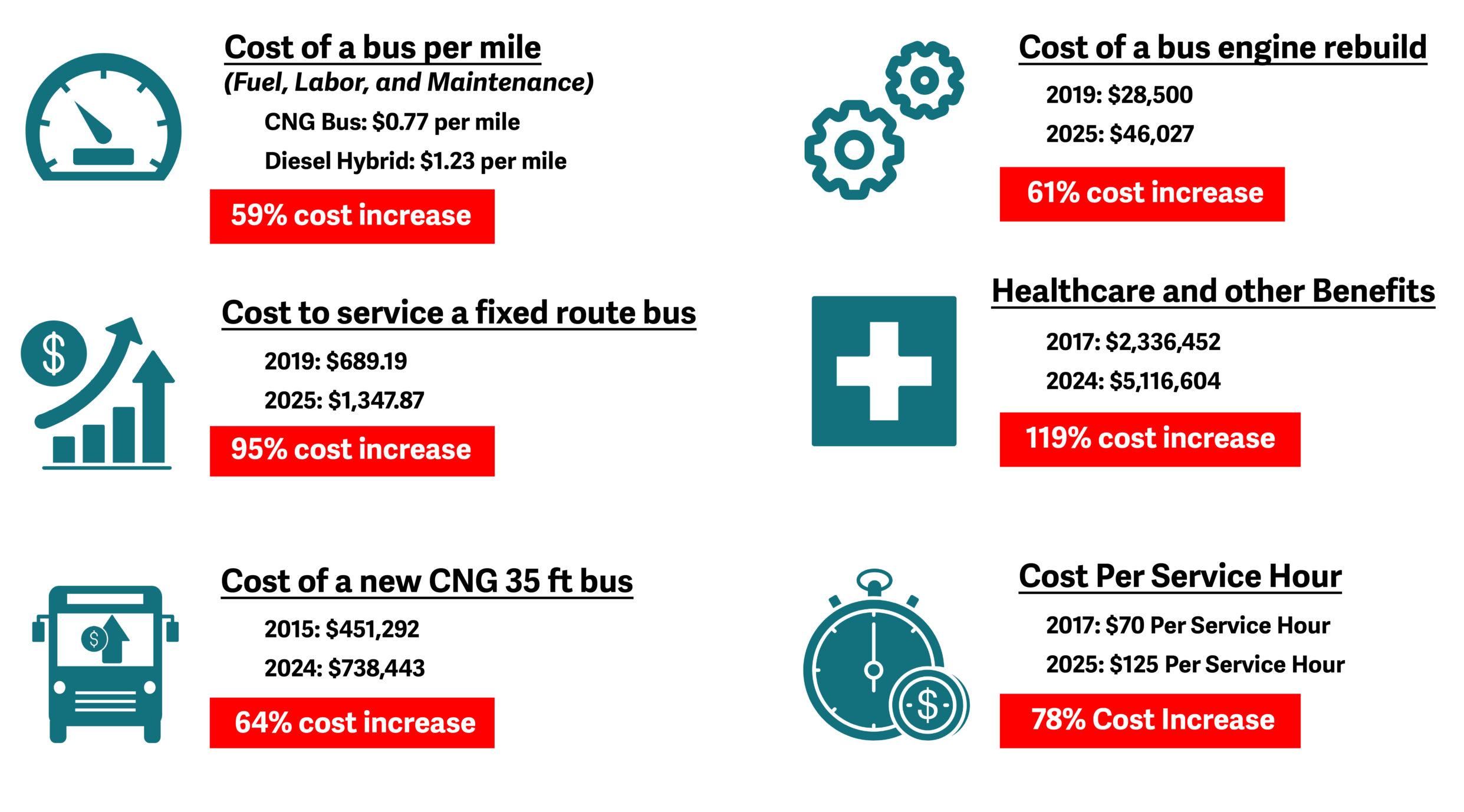
The rising costs of inflation, increases in health and vehicle insurance and providing competitive wages to retain professional drivers have greatly outpaced the revenue RVTD receives. For example, the cost to provide routine maintenance on a fixed route bus has increased 95% since 2019. The cost to operate a bus has increased by 59% for each mile we drive. RVTD’s healthcare and other benefits have risen 119% since 2017. This is similar to what other private and public employers are seeing.
RVTD has been advised by the Federal Transit Administration (FTA) to expect significant delays in our yearly federal funds due to decreased federal staffing and new Administrative policy. This temporarily required local and state funding to become the primary sources for ongoing operations. These sources were not enough to sustain the prior service levels and therefore forced us to reduce service in September 2025.
Additionally, in 2025, RVTD along with other transit agencies statewide have been seeking an increase in Oregon’s State Transportation Infrastructure Funds (STIF) transit funding. This effort not only fell short of the requested dollar amount to keep service intact but is now being referred to voters and may not ever be received by RVTD. This local levy being considered for renewal in May 2026 will help to maintain current service and restore some amount of service that was cut. To completely restore all nine routes, RVTD will need the levy to pass and a significant increase in the State STIF funds.
What did RVTD do to minimize cutting service?
RVTD prioritized maintaining bus routes that provide the broadest access and continue community connection. The routes with the highest ridership, that continue connectivity and that serve areas with higher than average low-income, minorities, older adults and persons with disabilities were preserved.
The routes that are still in operation serve more than 80% of RVTD’s ridership and they maintain service to 78% of the District’s population.
RVTD laid off 65 employees including 47 Drivers and 18 Administrative staff. By percentage, the Driver team had a 57% percentage of layoffs while RVTD’s Administration experienced 30%.
What cost-saving measures has RVTD done since then?
In addition to the reduction of 65 employees, RVTD also cancelled or amended several contracted services including janitorial, advertising and public relations, security and software agreements. The employee health insurance was transferred to a lower cost option and modified to require a higher employee contribution.
Currently, RVTD is evaluating all of its buildings, vehicles and equipment to sell underutilized capital items.
Should passengers pay more to sustain service?
RVTD’s per trip fare is $2.00 and it is one of the highest passenger fares on the west coast. Employer and school bus pass programs will be adjusted in 2027 to account for the value of the passes and increases in the cost of service. When RVTD increased its fare from $1 to $2 in 2006, we experienced an 18% decline in ridership. Therefore, passenger fares will never fully cover the cost because the rides will decline. Passenger fares, bus advertising, and clean fuel tax credits make up 16% of RVTD’s total revenues demonstrating RVTD’s commitment to balancing revenues from all sources.
Notably, all of our community’s transportation systems and infrastructure, including roads, bridges, freight, rail, and aviation are heavily subsidized by public funds just like transit.